
Thermal Energy Storage test module
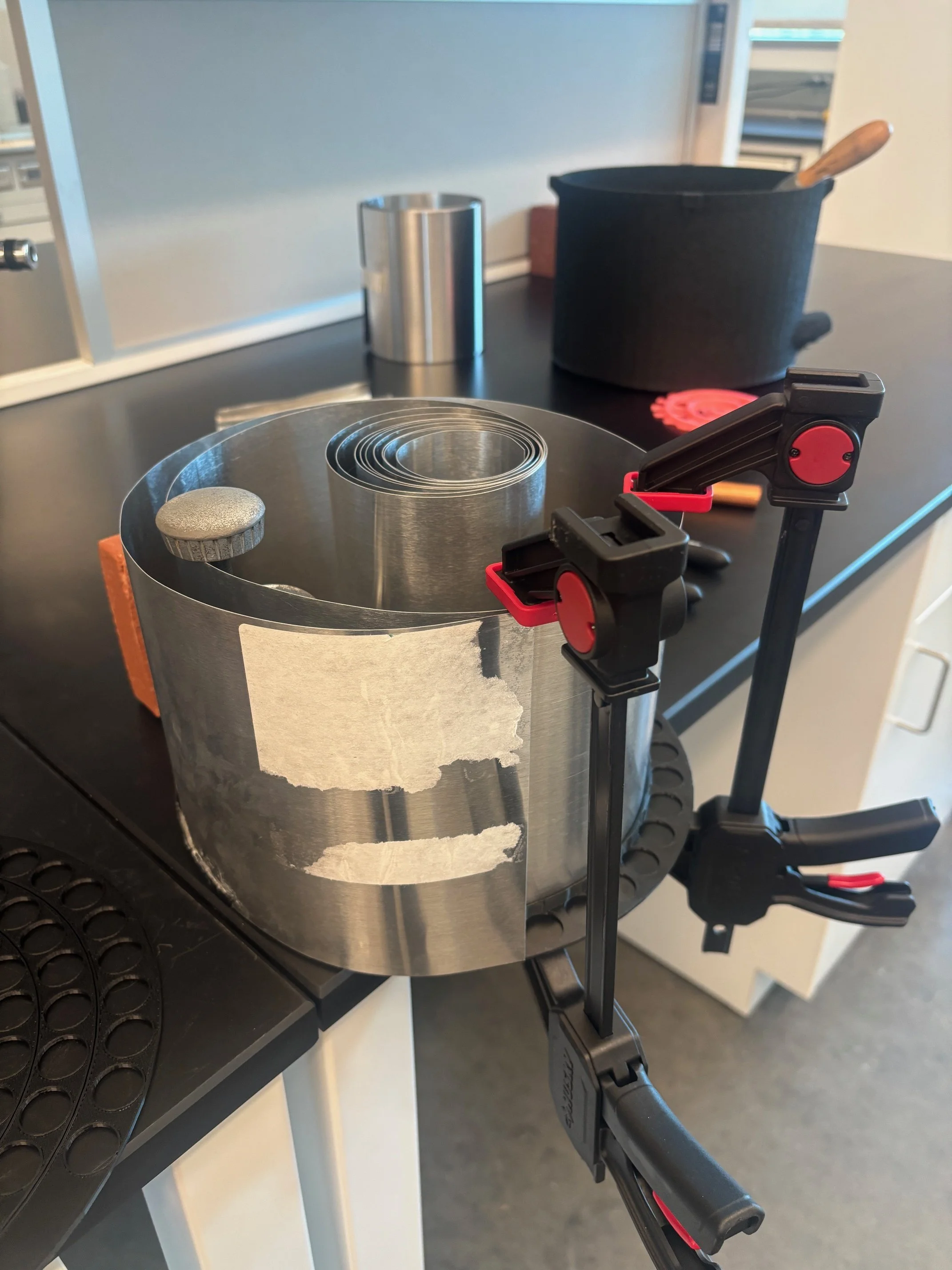
While working in the Renewable Energy Systems Lab at San Francisco State University, I designed a lab-scale thermal energy storage test module intended for integration within a cascading TES system. The module serves as an experimental platform to study heat transfer, flow distribution, and pressure drop, while supporting future research in system optimization and machine-learning-based dynamic control.
The geometry was developed in SOLIDWORKS and analyzed in ANSYS to evaluate hydraulic and thermal performance. A spiral heat exchanger architecture was selected to balance low pressure drop, uniform flow distribution, and ease of fabrication.
Thermal energy storage is achieved using embedded CrodaTherm 53 PCM capsules, chosen for its phase change temperature within the system’s operating range. The design combines aluminum flow channels with copper PCM tubes to leverage high thermal conductivity and improve heat transfer during phase change.
The system was designed so that cooler water flowing around the capsules enables energy discharge and PCM solidification. The copper shell minimizes thermal resistance, allowing effective solidification for sufficiently small capsules and adequate heat extraction time.
Overall, the module was developed as a flexible platform to study transient thermal behavior and guide future design optimization and control strategies.
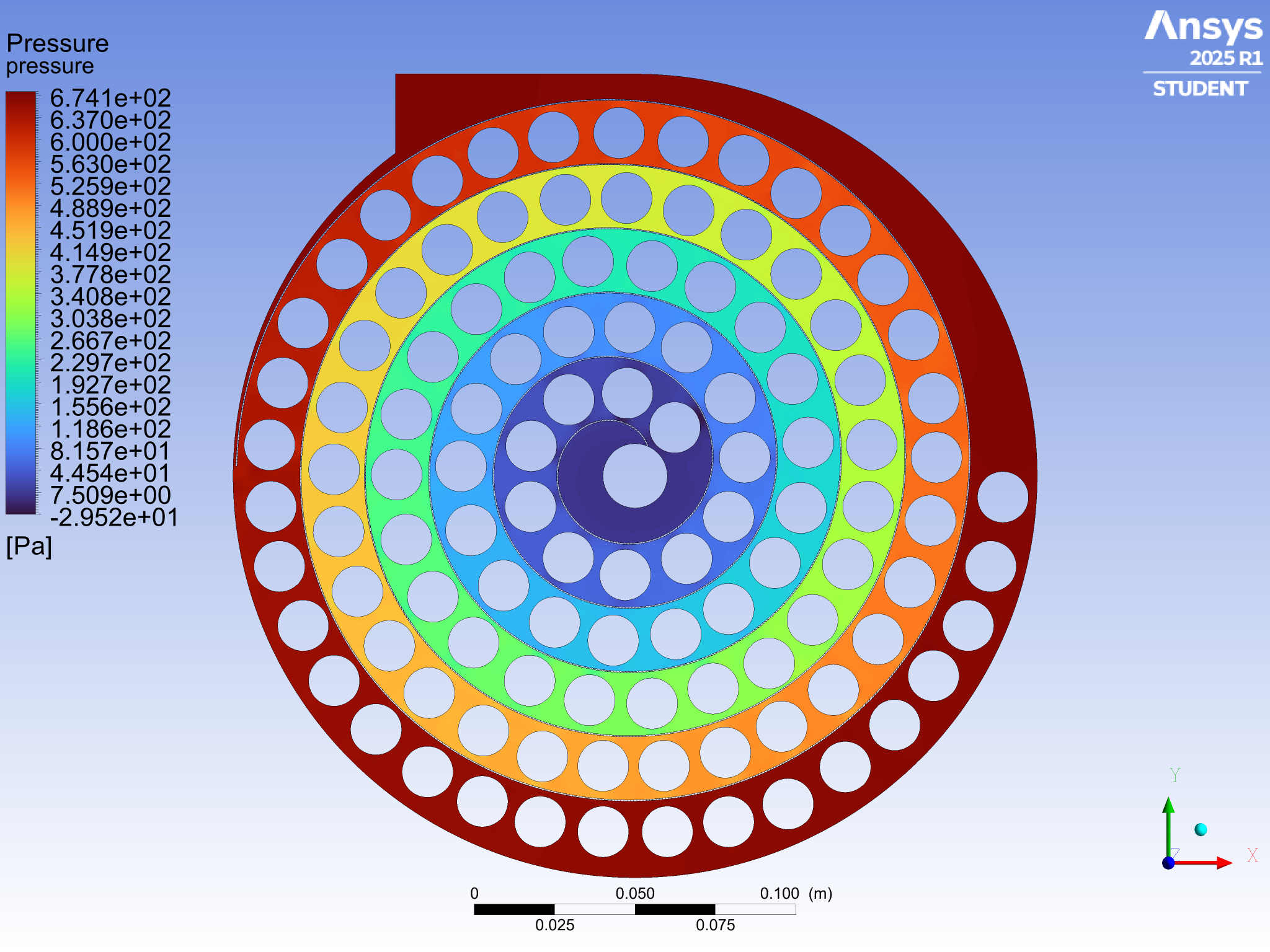
The spiral geometry maintains a low overall pressure drop (~700 Pa), indicating efficient flow distribution and low pumping requirements for a multi-module TES system.
The smooth, concentric pressure contours show that the flow moves through the spiral with minimal restriction despite the curved path and embedded PCM tubes
The main weakness appears near the center outlet, where the tighter pressure contours indicate localized acceleration and a suction action because of the - pressure.
For the next iteration, the final spiral turn and outlet hole should be widened slightly to reduce the pressure buildup near the center.
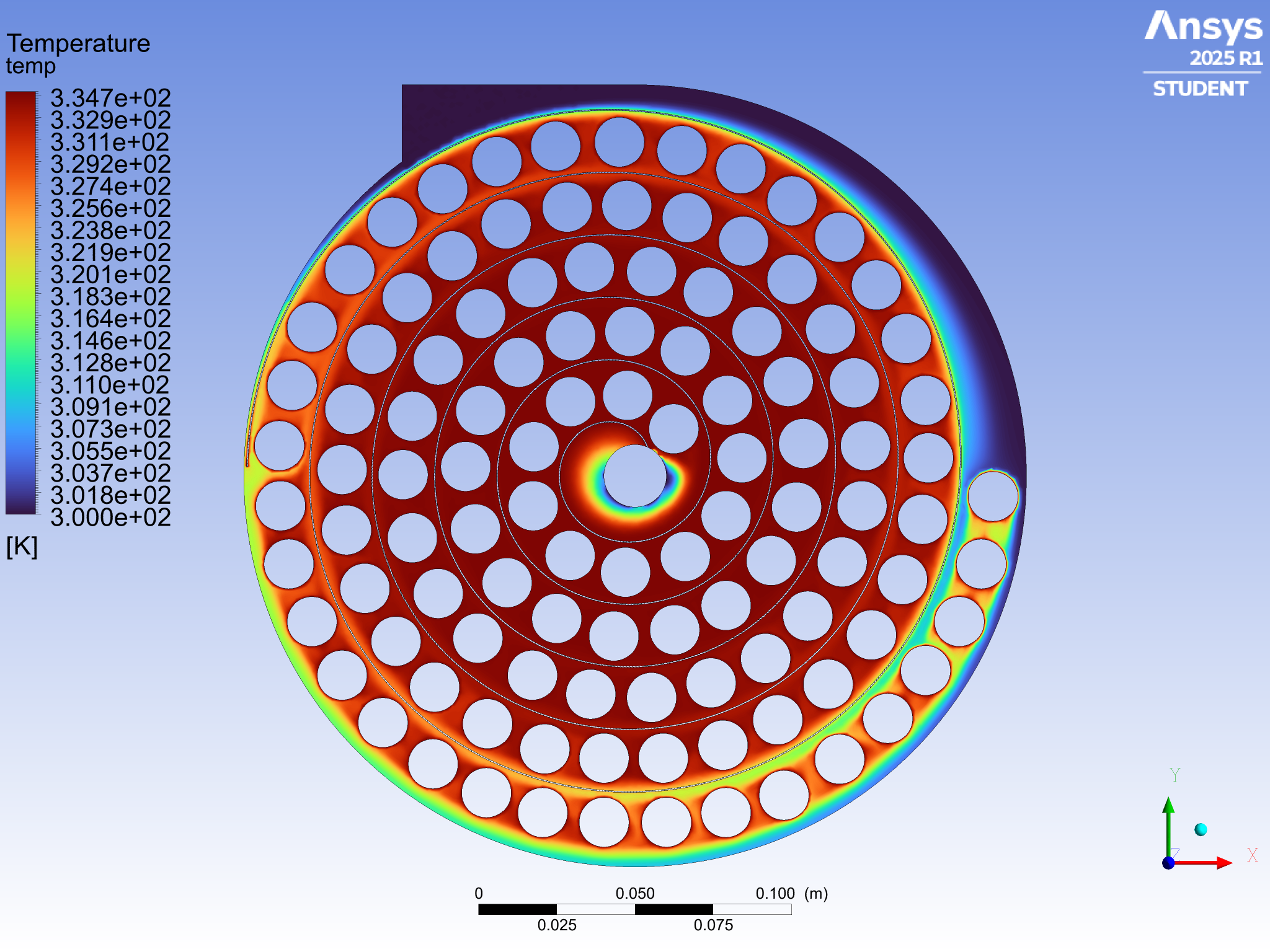
The temperature field remains relatively uniform through most of the spiral, indicating that the aluminum walls and copper PCM capsules distribute heat effectively.
The central outlet region also shows a localized temperature drop, likely caused by increased velocity and reduced residence time near the outlet.
In the next iteration, increasing the channel width near the center and slightly reducing capsule density near the inlet could improve temperature uniformity and reduce these localized hot and cold spots.
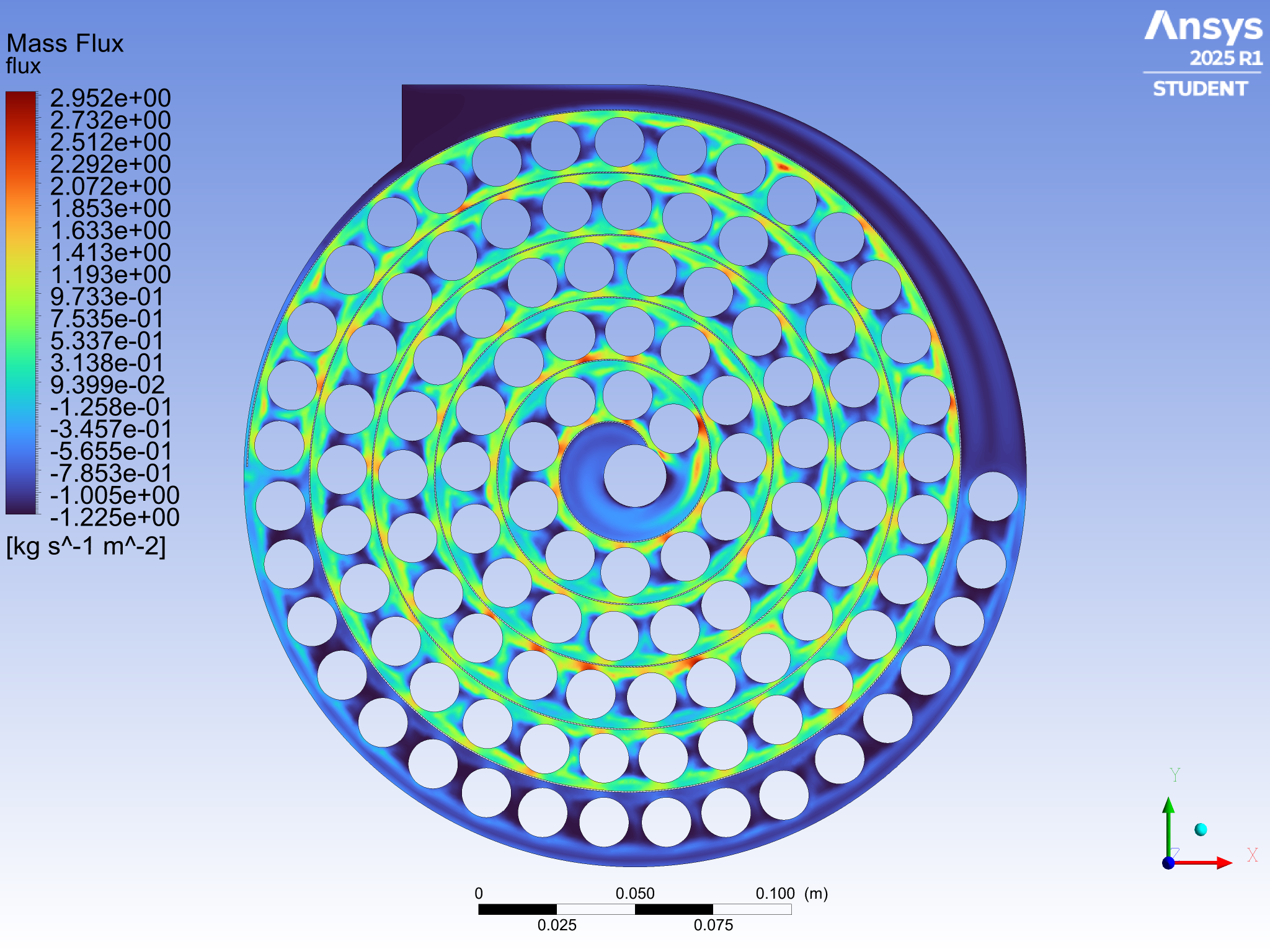
Mass flux remains relatively uniform through most of the spiral, indicating that the geometry distributes flow effectively and avoids major bypassing between PCM capsules.
The consistent flow around the capsules suggests good interaction between the working fluid and the thermal storage surfaces, which should support uniform PCM charging and discharge.
Regions of elevated mass flux and turbulence appear along the curved turns and between closely spaced capsules, indicating enhanced mixing and stronger convective heat transfer.
The strongest mixing occurs near the inner turns and outlet region, where the flow becomes more constricted. While beneficial for heat transfer, this may also create localized overcooling and higher pressure losses.
Small low-flux wake regions are visible behind some capsules, particularly near the outer inlet turn, showing that not all capsules are utilized equally.
In the next iteration, slightly increasing capsule spacing near the inlet and widening the innermost channel could reduce wake formation, improve flow uniformity, and maintain strong convective heat transfer without increasing pressure drop significantly.
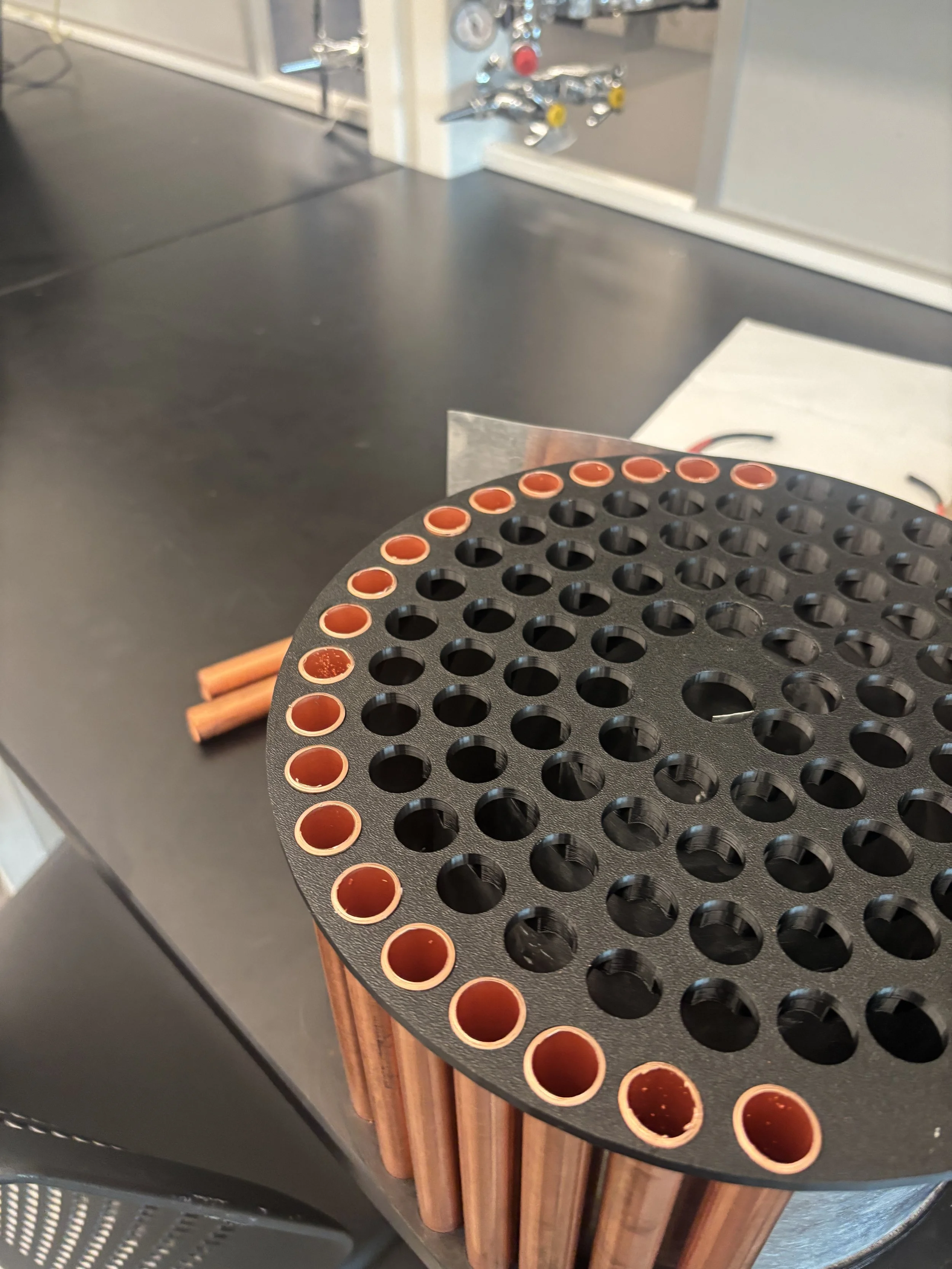
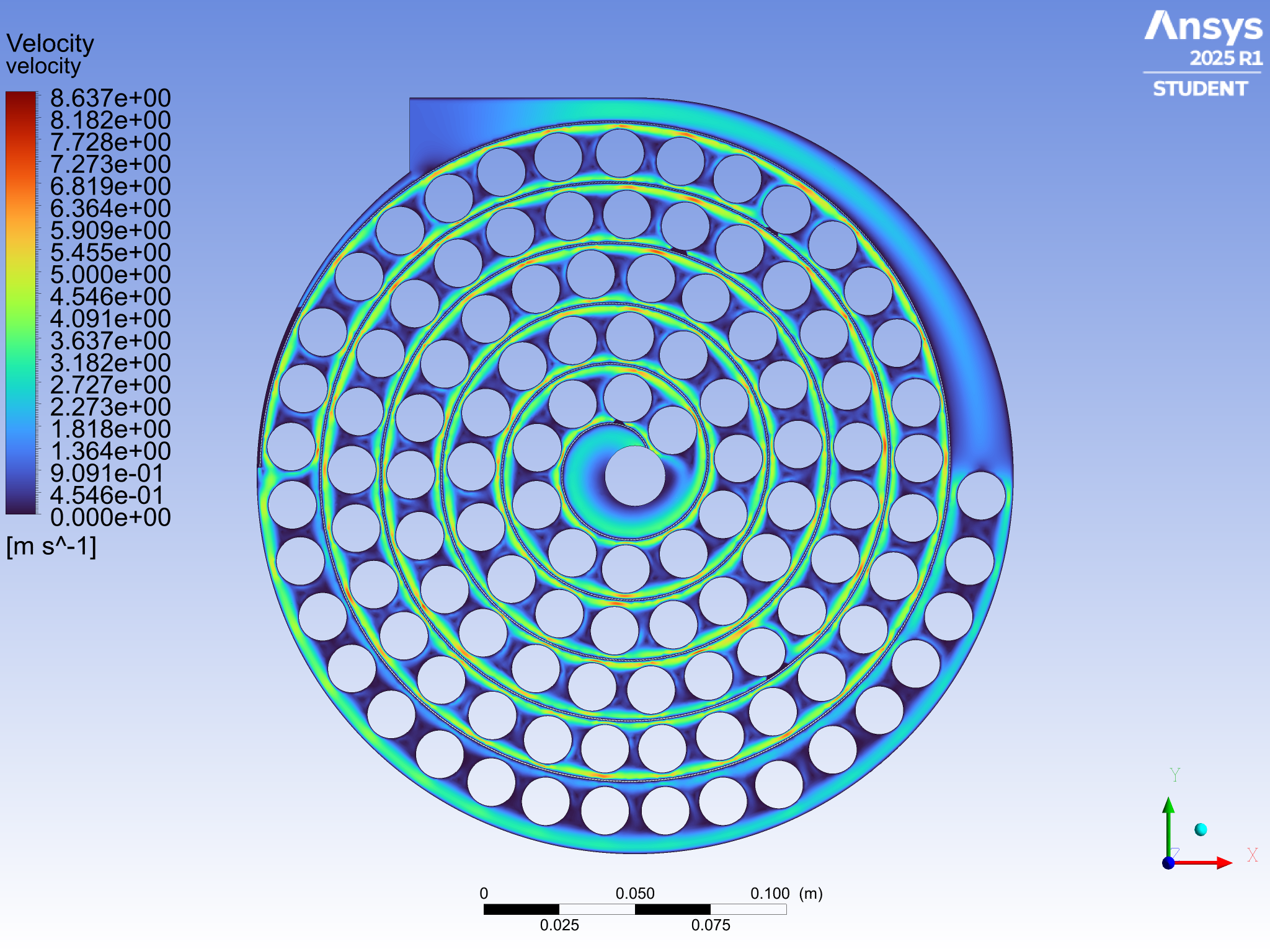
Flow remains continuous throughout the spiral, with no large stagnant regions or dead zones between PCM capsules.
The curved spiral path and closely spaced capsules create localized acceleration, which increases convective heat transfer and should improve PCM charging and discharge rates.
Velocity is relatively uniform through the outer and middle turns, indicating good flow distribution across most of the module.
The highest velocities occur near the inner turns and outlet region, where the narrowing flow area produces localized acceleration and potential over-utilization of the innermost capsules.
Lower-velocity regions appear in the wakes immediately behind several PCM tubes, especially near the outer inlet turn, suggesting some capsules may receive less effective convective heat transfer.
For the next iteration, slightly increasing channel width and staggering capsules eccentrically.
The proposed design demonstrates strong viability as a lab-scale thermal energy storage test module. The spiral heat exchanger geometry enables effective flow distribution with manageable pressure drop, while the combination of aluminum channels and copper PCM tubes supports efficient heat transfer and energy storage. Overall, the system provides a practical platform for studying transient thermal behavior and validating heat transfer performance in a compact and controlled setup.
From a manufacturability perspective, the design is well-suited for prototyping, with aluminum offering good machinability and the spiral layout allowing relatively straightforward fabrication. Improvements could focus on enhancing thermal uniformity through geometry optimization, refining flow distribution at the inlet and outlet, and simplifying assembly for better repeatability. Future iterations may also explore modular designs or alternative materials to improve scalability and ease of testing.